Posts

The Noble sport of Rugby by the Port Hills

Image

Sunday walk in the Port Hills

Image
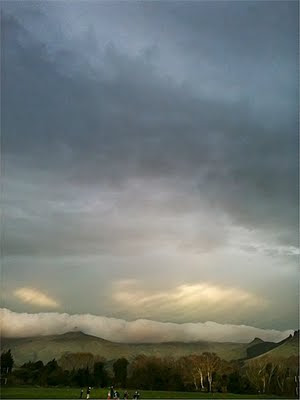
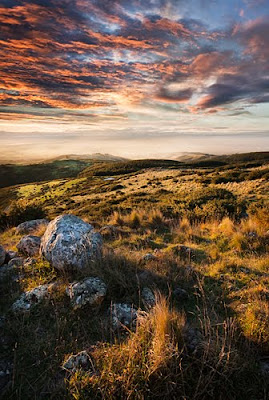
Christchurch under the mist Having done all the allocated jobs for today, I slipped out for a walk in the Port Hills. The place was packed with walkers and cyclists. Haraki or Flax, and the Southern Alps. I stopped at Kennedy's Bush and watched the sun go down behind the Alps. I even felt a low rumble of an after shock, but by now I had already checked were the nearest bolder was and its chance of being dislodged. So I relaxed till the next one. The Canterbury Plains and the Alps I can't help, but be reminded of Dartmoor, where I grew up, when I walk in these hills. View to the Southern Alps

New Book

Image
Waipawa hall At last I have started on post production of the new book, "Community halls in small town New Zealand". It was a lot work photographing all these halls with John O'Malley. We had to split New Zealand as the project was so big, I got the North Island and John got the south. A bit inconvieniant for me as we both live in the South Island. Papatawa hall We even found halls that weren't on the list, like Papatawa hall. This was a series of road trips that came to approximately 8000 kilometers of driving. The members of Pohangina hall New Zealand Halls are a defining part of our culture and still thrive despite the major changes that have happened to New Zealand in the last 60 years. Young and old still gather in these halls the meet have fun and keep the community going. Old and young in Pohangina hall

Photo pioneer Morris's collection goes under the hammer

Image
by Phil Coomes http://www.bbc.co.uk/news/in-pictures-13208423 John G Morris is a name that will probably mean little to most of you reading this, yet to news photographers and picture editors it's a name that most will recognise and hold in esteem. Morris' was the editor of photographer Robert Capa on D-Day and went on to help shape the look of the post-war picture magazine. He was also the first executive editor of Magnum Photos and worked at The Washington Post and The New York Times before moving to Paris in 1983 where he worked as correspondent and editor for National Geographic. Throughout his career he has built up a collection of original prints that are now being sold at auction on today, 30 April, in Paris . The pictures are both personal gifts from the artists as well as creative working prints from his visual diary. The prints being auctioned include pictures by Henri Cartier-Bresson, Robert Capa...

Joan Fontcuberta, from Lens Culture

Image
Joan Fontcuberta http://www.lensculture.com/audio.html Discusses image-making, the role of photography, media, reality – and propaganda. Excerpt: I am a Spaniard. I was born in 1955, and this means that for the first 20 years of my life I was suffering under dictatorship in my country: lack of information, propaganda, censorship. So this probably created a sense of fighting against the rules – of distrusting the official media. To be skeptical regarding how the authority, the power, was distributing messages and information. I think that my work is a sort of rebellion against repression, against this lack of freedom, against this lack of democracy, against this authority. I’m anti-authoritarian in my work. I try with my work to discuss the concept of truth, the concept of credibility – which is inherent in photographic messages. The heart [of my work], the quintessential, remains the questioning of photographic truth. Be careful, be ...
Gerda Taro

Image
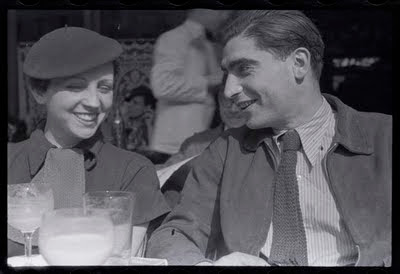
Fred Stein, [Gerda Taro and Robert Capa on the terrace of Café du Dôme in Montparnasse, Paris], early 1936. © Estate of Fred Stein. International Center of Photography Gerda Taro (real name Gerta Pohorylle ; 1 August 1910, Stuttgart - 26 July 1937, near Brunete , Spain) was a Jewish German war photographer, and the companion and professional partner of photographer Robert Capa . Taro is regarded often as the first female photojournalist to cover the front lines of a war and to die while doing so. Early life Gerta Pohorylle was born in 1910, in Stuttgart , into a middle-class Jewish Polish family. Pohorylle attended a Swiss boarding school . [ 1 ] [ 2 ] In 1929 the family moved to Leipzig , just prior to the beginning of Nazi Germany. Taro opposed the Nazi Party , joining leftist groups. In 1933, she was arrested and detained for distributing anti-Nazi propaganda. Eventually, the entire Pohorylle household was forced to leave Nazi Germany toward different destinations. Tar...

The Best from Zone Zero : The Mexican Suitcase

Image
Rediscovered Spanish Civil War negatives by Capa, Chim, and Taro SEPTEMBER 24–JANUARY 9, 2011 The Mexican Suitcase The Mexican Suitcase will for the first time give the public an opportunity to experience images drawn from this famous collection of recovered negatives. In December 2007, three boxes filled with rolls of film, containing 4,500 35mm negatives of the Spanish Civil War by Robert Capa, Gerda Taro, and Chim (David Seymour)—which had been considered lost since 1939—arrived at the International Center of Photography. These three photographers, who lived in Paris, worked in Spain, and published internationally, laid the foundation for modern war photography. Their work has long been considered some of the most innovative and passionate coverage of the Spanish Civil War (1936–1939). Many of the contact sheets made from the negatives will be on view as part of the exhibition, which will look closely at some of the major stories by Capa, Taro, and Chim as interpr...